
Key Takeaways
- Ceramides are lipids that naturally occur in the skin barrier. They hold skin cells together and prevent water loss.
- Barrier damage reduces ceramide levels, which can make skin more sensitive, reactive, and prone to dryness.
- Topical ceramides can help restore and reinforce the barrier, particularly when used consistently in a PM moisturiser or serum.
- A ceramide-reinforced barrier can significantly improve tolerance to active ingredients like retinoids and exfoliants.
- One ceramide product is enough. You don’t need ceramides at every step, just one good moisturiser or serum used consistently.
A while back I went down a rabbit hole trying to figure out how to make retinoids work without my skin staging a protest. Redness, tightness, peeling at the corners of my nose. The usual story. I kept reading about barrier repair as the solution, and ceramides kept appearing as the answer to that.
Not a new launch. Not a hyped serum with seventeen ingredients. Just ceramides, quietly showing up in every piece of barrier-focused content I found. So I swapped my usual lightweight evening moisturiser for the Purito Comfy Water Cream (a mid-weight moisturiser with ceramides), kept everything else exactly the same, and waited.
The irritation dropped noticeably. My skin tolerated the retinoid better than it ever had. I can’t attribute that to anything other than the ceramide moisturiser, because nothing else changed. That experience made me want to actually understand what ceramides are doing, and whether they’re as useful for everyone as they were for me.
What are Ceramides, and what do they actually do?
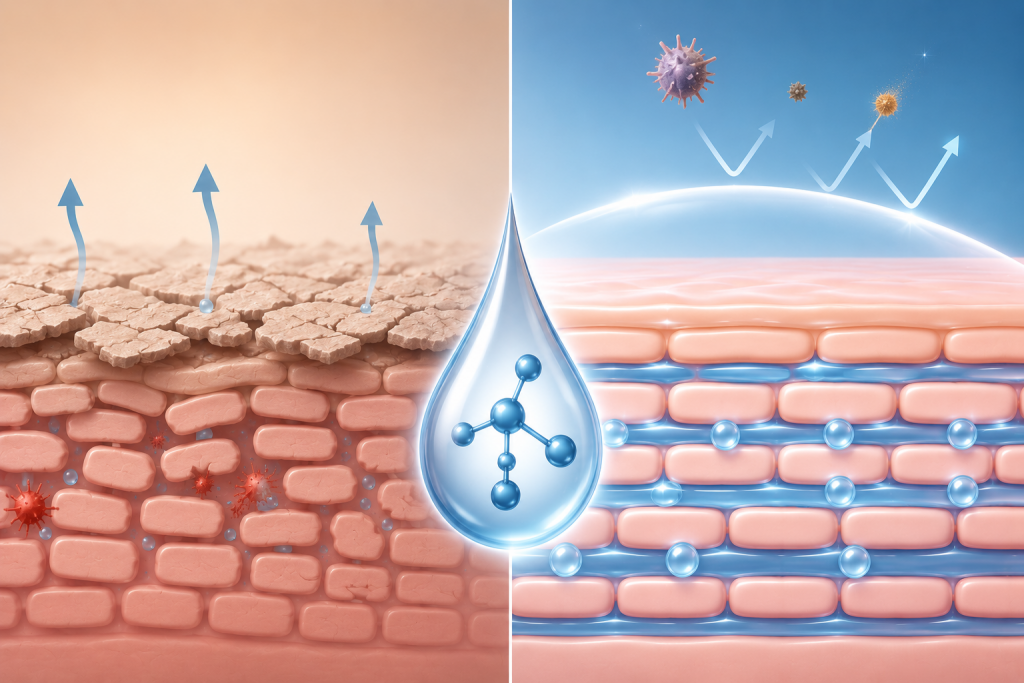
Ceramides are lipids. They naturally make up roughly 50% of the outer skin layer (the stratum corneum), where they sit between skin cells and act as a kind of structural mortar. That layer of skin, often described as a brick-and-mortar structure, relies on those lipids to stay intact.
Their main jobs are simple: hold the structure together, keep moisture in, and keep irritants out. When ceramide levels are depleted, the barrier becomes more permeable. Water escapes more easily. Potential irritants, allergens, and bacteria get in more easily. The result tends to be dryness, sensitivity, and reactivity.
Ceramide levels naturally decline with age. They also drop in response to over-cleansing, harsh actives, low humidity, and UV exposure. Which means most people using any kind of active skincare ingredient are probably working against a backdrop of at least some barrier disruption.
on the label
Ceramides are listed by type number on ingredient lists: Ceramide NP, Ceramide AP, Ceramide EOP, and so on. There are nine identified types in human skin. You don’t need all nine in a product for it to be effective. Look for at least one or two ceramide types listed reasonably high in the ingredient list, ideally paired with cholesterol and fatty acids (the other lipids that make up the skin barrier alongside ceramides).
A product that lists “ceramide” near the very bottom of a 40-ingredient list is mostly marketing. Concentration matters.
Do topical Ceramides actually work?
There’s a reasonable argument that ceramides applied topically can’t fully integrate into the skin’s own lipid matrix. The skin barrier is selective by design. But the evidence suggests that topical ceramides do improve barrier function in a measurable way, even if the mechanism is less straightforward than simply “replacing” depleted ceramides molecule for molecule.
Studies on ceramide-containing moisturisers in people with eczema and compromised barriers consistently show improvements in transepidermal water loss (TEWL), which is the measure of how much water is escaping through the skin. Lower TEWL means the barrier is doing its job better. That’s a real, practical outcome.
For people without a diagnosed skin condition, the effects are less dramatic but still present. Regular use of a ceramide moisturiser supports a healthier baseline, which tends to show up as less reactive, more comfortable skin over time.
A ceramide moisturiser won’t fix a compromised barrier overnight. But used consistently, it gives your skin the materials it needs to do that job itself.
Why a strong barrier makes actives easier to tolerate
Retinoids, exfoliating acids, and vitamin C are all capable of causing irritation, particularly when the barrier is already compromised. They’re also more likely to cause that irritation on skin that’s already stripped, dry, or reactive, because an impaired barrier is less able to buffer the effects of anything applied to it.
This is the practical reason to prioritise barrier health before introducing actives, or alongside them. A well-supported barrier doesn’t prevent the active from working. It just stops the active from causing unnecessary collateral damage in the process.
In my own experience, adding one ceramide-rich moisturiser to a routine that already included a retinoid made a significant difference to how my skin felt. Less tightness the morning after applying retinol. Less background sensitivity throughout the week. Nothing else changed. That’s the kind of simple, single-variable outcome that’s actually worth paying attention to.
Where Ceramides fit in a routine
Ceramides are found in moisturisers, serums, and occasionally in cleansers and toners. The moisturiser is the most useful format for most people. It’s the step where ceramides have time to sit on and absorb into the skin, rather than being rinsed off or layered under several other things.
The PM routine is a natural fit. Skin does its main repair work at night, and applying a ceramide moisturiser after any actives (not before) means you’re supporting that process rather than counteracting it. That said, there’s nothing wrong with using ceramides in the morning too, layered under SPF.
pm routine (retinoid user)
- Gentle, low-pH cleanser
- Retinoid (on clean dry skin)
- Ceramide Moisturiser (lock it in)
pm routine (no active)
- Gentle, low-pH cleanser
- Hydrating serum (optional)
- Ceramide Moisturiser
One ceramide product is sufficient for most people. There’s no need to layer ceramides at multiple steps. A well-formulated moisturiser used consistently will deliver more benefit than three products with ceramides listed as an afterthought ingredient.
What to look for in a Ceramide product
You don’t need to spend a lot. The skincare industry has done an impressive job of attaching premium pricing to ceramide formulas, but some of the best-performing products are mid-range or budget. What actually matters is the formulation, not the price tag.
WHAT A GOOD CERAMIDE MOISTURISER LOOKS LIKE
- At least one ceramide type listed in the top half of the ingredient list
- Ideally paired with cholesterol and fatty acids for a more complete lipid profile
- A texture you’ll actually use every day (cream, lotion, or gel-cream depending on skin type)
- A straightforward ingredient list without a long tail of fragrance, essential oils, or unnecessary actives
- No requirement to be expensive. Budget options often perform comparably to prestige equivalents
Are Ceramides suitable for all skin types?
Broadly, yes. Ceramides are a naturally occurring component of the skin, so topical ceramides are well tolerated across most skin types, including sensitive, acne-prone, and oily skin. They’re not inherently pore-clogging, though the other ingredients in any given product might be.
DRY / SENSITIVE
The most straightforward fit. A ceramide moisturiser addresses depletion directly and supports comfort over time. Richer textures work well here.
OILY / COMBINATION
Still beneficial. The barrier can be compromised even when the skin is producing plenty of sebum. Look for a lighter gel-cream texture to avoid congestion.
ACNE-PRONE
Ceramides are generally non-comedogenic. If breakouts occur after switching, it’s more likely another ingredient in the formula rather than the ceramides themselves.
MATURE SKIN
Ceramide levels decline with age. Supplementing topically makes strong sense here, particularly as a complement to retinoids or other anti-ageing actives.
The Bottom Line on Ceramides
Ceramides aren’t a trend. They’re a structural component of your skin that depletes over time and with routine use of actives. Putting them back in via a decent moisturiser is one of the more rational and well-supported things you can do for long-term skin health.
My experience was anecdotal, but it aligned with what the research suggests: a ceramide-reinforced barrier handles active ingredients more comfortably. If you’re using retinoids or exfoliants and experiencing irritation, that’s usually the first place to look.
You don’t need ceramides at every step. One product, used consistently, is enough.

